In 1983, Mike Coveney, the founder of the GSPS, managed to get access to the BBC Written Archives Centre at Caversham Park. During his brief visit he was able to take notes from the files on the Goon Show, Spike Milligan and Peter Sellers. He reports that, unfortunately, Harry Secombe’s file contained very little of interest to us, other than the usual contracts etc.
Mike’s report was originaly published over issues 37, 38 and 39 of the GSPS newsletter in 1983 and 1984.
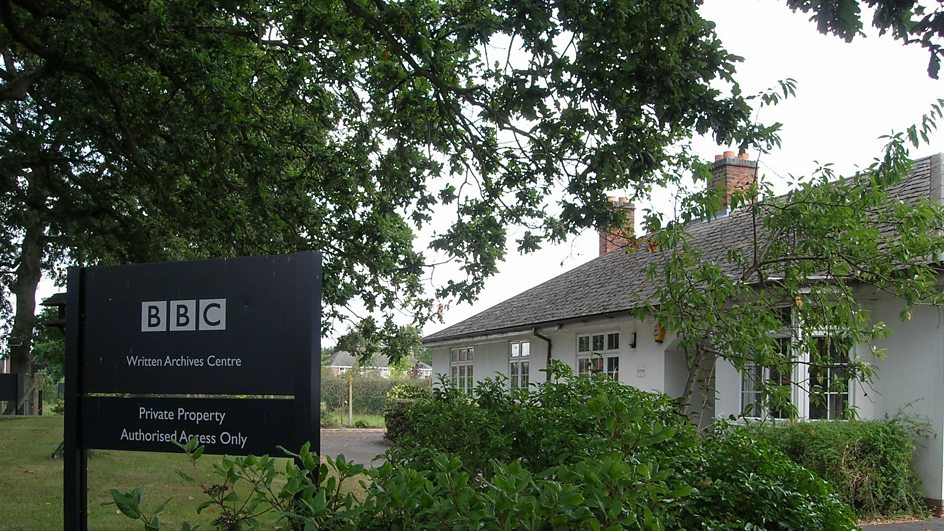
For many people, Caversham Park means the Monitoring Service of the BBC. It is a lovely building, currently being restored and extended, where the BBC listens to World Radio 24 hours a day, 365 days a year. However, in the grounds, a cluster of more modest buildings which look like wartime barrack huts, houses the BBC’s priceless collection of written papers.
The BBC’s written archives contain the complete record of how the BBC has carried on the business of making programmes from its beginnings in 1922. Letters, memos and minutes of meetings record the BBC’s policies and development, as well as its relationships with other organisations and with the thousands of people from every kind of background and interest who have contributed to programmes. Because these programmes reflect many different approaches to almost every subject, the papers are a unique source for modern social and political history as well as biography and broadcasting itself.
The majority of the papers take the form of correspondence files. Many contain letters likely to be of interest to the biographers of men such as Churchill, Vaughan Williams, Huxley, Russell and Bevin – letters showing how Bartok wished his music to be played and what Forster thought of religious broadcasting.
The BBC has always been one of the major patrons of music, and many famous musicians have been on the staff. Papers at the written Archives Centre relate to works specially commissioned for broadcasting as well as to major opera and ballet productions and individual composers and musicians. Other files cover the growth and development of the BBC’s own orchestras and singers, and the broadcast seasons of Symphony and Promenade Concerts for which there are complete sets of bound programmes.
The Centre holds the scripts, either on microfilm or in their original form, for many programmes both for radio and television. News bulletins (in English and in many foreign languages) can provide factual information in great detail about what was happening at home and overseas.
From the very beginning, as each programme went out over the air, a detailed log of each item was kept, known as the Programmes-as-Broadcast (PasB). Except for the wartime period, those relating to the domestic output were indexed and it is therefore possible to give more accurate information on what was broadcast from each station than is obtainable from the Radio Times, although complete runs of the Radio Times are maintained, together with The Listener and all other BBC publication’s including those for schools. Supplementary information can be provided from a very extensive and classified collection of press cuttings on broadcasters and broadcastings taken from the whole range of national and local newspapers.
Professor Asa Briggs used many of the papers for his History of Broadcasting in the United Kingdom, which in itself provides a useful indication. of their range and scope. With certain limitations, of which copyright is the most important, papers can be made available to bona fide researchers, but access is at present (in 1983) normally restricted to the period 1922-1954.
For the Goon Show enthusiast, there are files on each of the artists, including Michael Bentine. The files contain correspondence, memos, copy contracts, and all papers connected with the artist in his work on The Goon Show. Occasionally, a note shows that certain confidential papers have been removed, so researching often means assessing what is not in the file as well as what is there.
A Goon Show programme file contains papers between BBC staff and producers, the Head of Variety, Variety Bookings, Head of Light Entertainment and many others who were involved in the day-to-day problems of keeping the show on the air. This may come as a surprise to those who assumed the BBC’s main problem was how to take it off!!
Press cuttings were unfortunately rather sparse, although one file is available. A number of original scripts are held, each bearing last minute alterations and notes.
Turning over the pages of these tiles and other documents, one is easily able to return mentally to the 50’s and the atmosphere of BBC radio in those ‘Golden days’. In this article, we shall examine each of the files for interesting papers, which will give us more insight into the real history of the Goon Show.
However, as a starter, mention must be made of the very first letter in the Peter Sellers file. It was addressed to Michael Standing a senior executive of the time, and was written in Peter’s own hand on a printed letter heading, rather crudely drawn with ‘PETER SELLERS – BANG ON’ in large type. Peter requests an audition with the BBC, and lists some of his specialities, including voices. The writing is simple, modest, and rather touching. However, the letter drew very little response, and a stereotyped reply asks him to contact Dennis Main Wilson, then a junior variety producer. This initial contact no doubt led to the famous phone call to Roy Speer’s office, when Peter impersonated Kenneth Horne, and the result being known to us all.
Four files were made available during my visit, personal files of Spike, Harry and Peter, and the general Goon Show file. Copies of letters, contracts, and other papers are all meticulously filed – many memoranda include pencilled notes by various officials. As problems arose and advice was sought from other departments.
It was difficult in the short time at my disposal to extract the best items, but the following is at least a sample of the sort of correspondence that I found.
The Goon Show file
The very first entry is from the Head of Variety to Ian Messiter, who is still with the BBC doing panel games etc. A trial programme of the Goons is agreed, to be produced by Pat Dixon, and cost not more than £125 (this is not a misprint). This sum was to come from the “experimental fund”. Later a Home Service trial provided Spike with a handsome fee of £7.17/6d. Even at this early stage, memos indicate the General Overseas Service would be interested in taking the show.
Dennis Main Wilson’s memos show some light on the pressures that no doubt existed as this new show gradually got off the ground. In one he complains “Sellers thinks what anybody else is thinking at any given moment”. Bentine and Grafton were keen to think about putting the show on TV, but no one else agreed.
At the beginning of 1952, Main Wilson prepared four foolscap pages outlining ‘general policy’ concerning the show. Length precludes reprinting it in full in this article, but see the extract below. However, the top brass of the BBC were getting a bit worried about the style of the show – the Head of Variety (H/V) wrote to Main Wilson on 29/5/52 saying that the Goons “were in danger of being submerged by qualities that had helped their success, e.g. gusto and eccentricity”!
Main Wilson was concerned about the acoustics at the Playhouse Theatre where the early shows were recorded – the stars were adversely affected by the “cold” feeling. He also mentions signs of a rift between Spike and Larry Stephens. “Milligan is an excellent gag and ideas man” he says.
Peter Eton’s memos are fairly tersely worded, although there was little real sign in the files of any campaign to get the show off the air. It must be borne in mind that some confidential papers are removed from the file however.
On 1/3/54 he wrote to H/V after Spike had met John Snagge. Spike was very gratified to find that Snagge, who was well up in the BBC establishment, was most encouraging. However, Spike did come unstuck with that establishment at the end of 1953. The Flying Saucer Mystery broadcast on 4/12 contained some realistic announcements that had the usual morons ring up the BBC to say they had been worried because they thought we were being invaded from outer space. This incident was taken very seriously and memos were exchanged right up to the level of the Controller, Light Programme.
Producers had to observe a strict code of practice in the matter of ‘realistic’ announcements on such matters as war, space invaders, etc, and this script over-stepped the mark. Early in 1954 the show was in trouble again, this time with the press over ‘uncouth language’- “you filthy swine” was amongst the phrases objected to.
By the middle of 1954 rising costs were worrying the admin side, and Eton had to carry out a costing exercise. A breakdown of the fees is as follows:-
Script £89
Sellers £36
Secombe £31
Milligan £18
Ellington £ 5
Orchestra £48 (12 musicians)
Geldray £18
In a memo later this year, Eton mentions the fact that Wally Stott was losing interest in the musical side because of the drastic pruning of the size of the orchestra. This was to save a mere 15 guineas.
An interesting few memos were exchanged between the producers of the Goon Show and Hancock’s Half Hour. The idea was proposed that a running gag be put in between the two programmes, but the project was abandoned when it was realised that Hancock would require an extra fee of 5 guineas for a minute spot.
Although these apparently petty monetary matters seem strange to us after thirty years, it is difficult to blame the BBC as they had a strict budget to adhere to. In fact from the files that I saw, there was little evidence of “officialdom” in the worst sense. However Spike thought very differently, and his views must be respected. Radio has always been the poor relation of entertainment however. In the early years it was films that commanded the big money, as it is television today.
The Spike Milligan File
Spike’s file reveals an early appearance on Opportunity Knocks on 14/2/49 for a fee of £5. His address is given as 2 Strutton Ground, SW1, where of course Jimmy Grafton had his pub. Some time later, Spike put the BBC address at the top of his personal letters, and was carpeted for doing so (Sellers had the same trouble). For young men trying to get going in radio, no doubt they felt that by using the BBC address a certain amount of prestige would be gained.
Sellers and Milligan were able to use the power of the BBC to get telephones at their home addresses. Phones were extremely difficult to get hold of at that time, but were very essential for bookings. The GPO were very sympathetic and usually helped.
In 1953, Spike’s agent is given as Kavanagh Productions Ltd – which would be the famous Ted Kavanagh of ITMA fame. At this point, letters from Pat Newman, head of variety booking at the BBC commence, and they are very good humoured and ‘goonish’. Spike’s letters are earthy, quite rude often, and make good reading. In one he ends “since the party I have not seen Eric Sykes – will you get the cleaners to have a look for him”.
To round off this part, we go forward to 1955 when “Associated London Scripts” are acting as Spike’s agency. A letter from Beryl Vertue to Variety Booking:-
“with regard to his contract, Spike Milligan has asked me to write on his behalf, to request you to consider raising his fee to 20 guineas. He realises this is slightly more than the Railway men are asking for, and hopes a general strike will not ensue”.
Before leaving Spike’s file in the archives, it is worth noting the ambiguity of the letters at the end of 1960, when there was uncertainty as to whether or not there would be another series.
In October 1960, the planners were “waiting for a decision” by Spike and in March 1961, there was a request by Spike for payment of scripts written but not performed. It seems definite that an eleventh series could have happened, and John Browell has admitted to taking the final decision to close down the Goon Show. The evidence is somewhat conflicting, and Spike is quoted as saying “we got out while we were still at the top”. Perhaps some file as yet unseen has the complete answer to this enigma.
The Peter Sellers file
Now we turn to the final file – Peter Sellers, and as we noted earlier, the first document was a handwritten request for an interview from “PETER SELLERS – BANG ON!!”. An early audition provided this comment from an unnamed but senior producer “very good mike voice – material old and weak”.
In August 1948 a letter from Sellers’ agent requests the BBC not to announce him as “that young man from the Gang Show”. The embryo star was already charting his course to the top, and any connection with amateur theatre was to be severed immediately. The writer remembers an appearance by Sellers in a Sunday concert in Ramsgate in 1948. The billing described him as “an up and coming star who would soon be top of the bill”.
Another letter in Sellers’ own hand early in 1951 apologises for using Broadcasting House address on his personal notepaper. Prestigious as it was, the practice was not allowed. It was not long before his BBC engagements began to pile up and even overlap. A letter to Variety Booking says he will suffer a nervous breakdown if he does not get a break, though this seems to have been a ploy to get a holiday in France at a time when he had two shows running.
There are one or two letters from The Lew Grade Agency on the delicate subject of billing, and it was time for Sellers to claim the top!! The assistant Head of Variety wrote to his chief saying Peter was excelling himself and “can we star him in a new show”. Despite all this he had to claim for travelling expenses – in June 54 this was £5 18/9d.
Some inter-departmental warfare sprang up over a record programme for Sellers, scripted by Jimmy Grafton. I have not been able to establish whether the show actually went out, but apparently the BBC thought little of the script, and the gramophone department was soundly castigated for the item.
Moving on to 1955, we find in November that Peter was sacked by the producer of the Goon Show (Peter Eton, who told us in his talk at Margate about this). This was due to some inadequacies in performance, and incurred a strong letter to Peter from the Head of Variety, and a somewhat apologetic reply was sent.
In January 1955 the files record another difficult period, with Pat Newman, Head of Variety Booking, appearing to realise that Sellers ‘threats of not wishing to be associated with the Goon Show ever again’ should be taken with a pinch of salt. Newman was obviously a good executive and was able to resolve such problems with good humour.
Fees in 1956 had risen to £70 for Harry and Peter, but Spike had to rub along with £55 – though of course he also had the script fee.
The following is part of the general section of the notes made by Dennis Main Wilson in 1952.
THE GOON SHOW – SECOND SERIES
- We shall go all out to identify the Goon performers with the characters they play in the show – a great necessity as we have discovered from listener research reports
- We shall keep down to the dialogue pace that I developed in the last three programmes in the 1951 series (this slightly slower pace was largely responsible for the sharp rise in listening figures towards the end of this last series).
- We propose to make a weekly speciality of the ‘Goon running gag’ which occurs in various guises three or four times in the half hour and which we use to play off the show after the closing announcements.
- We propose to keep Baron Bloodnok, Captain Pureheart, Abdul and Ellington from the last series. Harry Secombe’s character for the opening spot will be expanded into “Handsome Harry Secombe” – whom we hope will turn out to be a very strong character, embodying Superman, Dan Dare, Flash Gordon and Dick Barton.
Naturally, he will turn out to be the most death defying comedy coward of all time. The Eccles character we shall keep, but we shall re-name as Spike for easier identification of Milligan. - At present the writers are wrestling with “a Goon History of the World” for the final spot for the programme. Should they succeed, we shall keep it as our permanent climax.
- With regard to the musical items, I shall keep Max Geldray in the same style as last year. The Stargazers have developed a new style for the show on the lines of an English Mitch Miller. The Ray Ellington Quartet spot we hope to broaden into more ‘personality comedy’.
- At the end of the first spot in the show, Harry Secombe will go into half a chorus of a popular song (as he did in the last programme of the 1951 series).
- We hope that Planners will agree to build the programme as “the Goon Show” rather than “Crazy People”. This is purely because everybody, both in and outside the business, refers to it as the Goon Show (or that Goon Show) but never as Crazy People (which quite frankly could be applied to almost any comedy show).

The article above was written over 40 years ago.
More information on the BBC Written Archives Centre at Caversham Park today, and how to access it is available on the BBC website.
The Radio Times archive can be viewed online through the BBC Genome Project.
 The Goon Show Preservation Society