Transcript from the GSPS meeting in May 1996, known as An Evening Called Fred.
Part 3: Brian Wiley remembers Peter Sellers. John Browell remembers Sellers in Rome.
John P Hamilton: And after the Goon Show, John retired rapidly thereafter. No, he didn’t, he went on and did many other things. Including the ever-running Sing Something Simple, of course. Not any more, but for many, many years thereafter with dear Cliff and the singers.
John Browell: Thirty seven years it’s been on the air. Brian, who’s as good as ever, was with me at the beginning.
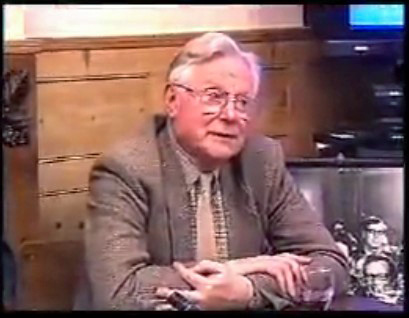
Brian Willey: Well, I don’t know what I’m here for. John’s done a wonderful expose of everything, and I totally endorse what he said. They weren’t happy shows for us technical staff. I can remember, because I’d never done the panel before on The Goon Show. I’d done odd occasions on GRAMS. I hadn’t done spot effects on The Goon Show, I did spot effects on the first Crazy People, which was an alien one, when Bentine was in the group, Dennis Main Wilson, Stanley Black and the Dance Orchestra. I did a few of them and certainly began it. Actually, it’s interesting, I didn’t know Bentine at the time, didn’t know of him at all, but he was a member of the cast.
We had an old gramophone horn in the sound effects lab, it was a copper horn, about this sort of size (uses hands to show about two feet wide) and we used to use it for all sorts of things, washboard, throwing about, made a nice clang. I can’t remember who was on the panel for that show, could have been John Simmonds.
John P Hamilton: Keith Fell took the majority of them, could have been Keith, a lovely guy, died much too young. And, harking back to my reminiscences again, he did the Star Bills that I did with Dennis. I did the FX on, or grams on at the Garrick Theatre. He managed to get the lease to use the Garrick as a radio studio, or do a wangle within the BBC. Keith had balanced nearly all those, Forces All Star Bill, while the guys, some of them still in uniform, and then All Star Bill, out of which came Hancock and, as Dennis reminded us, the writers Ray Galton and Alan Simpson, who’d written most of those shows. Sunday shows, which we did live out of the Garrick, with Tony and Beryl Reid and all sorts of people. Sellers occasionally popping in and out, Terry Thomas, people like that. Just doing single spots, no real sketches and such. But out of that came Hancock, and a long-running association between Keith Fell as the panel man and Dennis Main Wilson. So Keith probably did the show.
Brian Willey: It was Peter Kempton, I’m pretty sure, on spots for that show. I can remember this horn sat at the side of the stage, and the audience was in, it was a warm-up for the show, Dennis introduced all the cast, and introduced Michael Bentine who, just off the top of his head, walked across, picked up this horn and did things with it, like a mine detector, it was a coolie hat, it was a megaphone, all sorts of wondrous things. And I was most impressed with this man, just as a spontaneous thing, using this piece of artefact as a prop for himself.
I didn’t work on many of them, and actually my bent was music as a studio manager. I used to do the Showband with John (Browell). I never did the variety shows until the ninth and tenth series when John was the producer. I cut my teeth on sound effects with ITMA. I joined the BBC back in 1944 and after a few months I was in the Variety department and doing ITMA. I eventually got called up. The funny thing about us in those days, we were ordinary people, we weren’t engineers in any sense at all, but they called us chargehands of wireless receiving and transmitting equipment, and it made us exempt from the forces for some considerable time. I was about eighteen, nearly nineteen, before I got called up, and I was a moron. Anyway, I did my national service, and during my national service Tommy Handley died, so that was the end of ITMA.
I came back to the BBC. By then, one became a trainee as an engineer, panel operator, and you did sound effects as a by-the-way situation while you were studying. John, I was always envious of you. You seemed to come out of nowhere to being a panel operator. You never seemed to haul yourself up like we had to.
John Browell: I told you I was devious… I wasn’t sleeping with the producer, I can tell you that! (much laughter)
Brian Willey: The Goon Show wasn’t a happy show to work on. I can remember on one occasion when Spike and Peter had fallen out. Peter wouldn’t work alongside Spike on this occasion. I was up in the sound cubicle:
“Brian, Brian” Peter was beckoning me down onto the stage. “I want my own mike for this show”. So I had to put out another cast mike and they were yards apart. Wouldn’t talk to each other all day, dreadful situations. Harry, on the other hand, was always wonderful. Harry was quite immovable. He was a very strong man too. I remember on one occasion setting up the microphones for the orchestra and, unbeknownst to me, Harry had crept in onto the stage, walked up behind me, grabbed me by the bum and lifted me up (indicates above his head). An amazingly strong man. He never did it to you John?
John Browell: Oh no, I weighed a little more…
Brian Willey: But he was the lovely one amongst them, he was the soul of sanity, believe it or not.
I first met Peter, as John recalled, with Elsie and Doris Waters. Do you remember Jack Warner? Elsie and Doris Waters were his sisters, and they had a radio show called The Floggits where they had a shop, a little general store I suppose. They had an errand boy, and the original errand boy on those shows was Tony Newton, and when Tony left the show Peter Sellers took over as the errand boy. That was my first instance with Peter Sellers.
John Browell: He was doing voices man in several shows. Peter is marvellous with voices and that was his profession.
Brian Willey: Stand up, the real Peter Sellers. There was never a real Peter Sellers, he was always someone else. I worked a lot with him, I used to do the panel on Ray’s a Laugh, Ted Ray, with the producer Leslie Bridgemont, and Peter was on those shows. He was a great stalwart.
John P Hamilton: Crystal Jollybottom, and the awful boy. And interestingly enough, that awful boy was probably the forerunner of Bluebottle.
Brian Willey: My last meeting with Peter Sellers is a very sad memory. Because I’d always been involved with music balance I’d got to know a lot of people in the music business, and I got to know Henry Mancini, who often used to visit this country. He invited me to a Philharmonic concert he was conducting in the Royal Albert Hall. I went along to it, went back to his dressing room at the interval to see him. He said “There’s a friend of yours in the corner of the room”. I looked over and it was Peter leaning against the wall. I hadn’t seen Peter for years. He was dejected, head down, standing against the wall. I went up to him and I said “Peter, you won’t remember me, but I used to work on the Goon Show”. I held my hand out and he just looked at me and he said “So?”. I walked away and went back and I said “He’s his usual cheerful self”. And that was my last recollection of Peter Sellers, which is a very sad, unhappy memory for me, because we’d had great times on The Goon Show. There was the new car, practically every week, so the first thing that happened, as we were there early, was the crew setting up the studio. Sellers would come in and say “All outside, see my new car”. A Studebaker one week, a Chevrolet another week, the money he spent on cars must have been astonishing.
John P Hamilton: The first of everything really. Certainly in movie cameras. We used to run up and down and do effects for him in the attic where he’d set up a cinema, in the house when he lived at Barnes, with a lovely lady, his first wife, Ann. Graham Stark used to come up and do bits and pieces, and Harry took the stills, and a regular thriving little film industry went on. Some of them were very good actually. He would have made a very good film director, Peter. He was a great performer, he would have made a great director as well, marvellous eye.
Sellers in Rome
John Browell: Yes, wonderful in that respect, but no respect for money at all. He and Blake Edwards went through nearly a million pounds and had nothing to show for it at the end of it. In fact, Peter dropped me in, I did a series ‘Peter in…’. The first one was Sellers in Rome, and he sent me over a cassette to use in the programme, which was an interview he’d done with Sophia Loren. He’d recorded this on the Via Veneto, or whatever, at a table and it was all outdoors. It was very good, and he is various people coming up to Sophia and chatting her up.
The BBC was very primitive, I didn’t have a cassette recorder, didn’t own such a thing, so I had to have it copied overnight onto tape for use in the programme. I sent it over, and they used to arrange to do all this copying overnight, and a rather elderly lady copied the tape.
Unfortunately, when she got to the end of side 1 she turned it over and started to record side 2. Side 2 was Peter Sellers and Blake Edwards, very very drunk, acting out some rather dubious scenes on a film set. The poor lady had a fit. She stayed on in the morning rather than going home to bed and got the Head of Recorded Programmes to come to the recording channel, and she played a bit of this to him and said “what on earth am I going to do?”. So they sent for me. We sat solemnly in this recording channel, and listened to thirty minutes of nothing whilst the tape was erased. When you erase a tape you don’t hear anything, so I never knew what was on that tape.
An Evening Called Fred
continue to Part 4 >
 The Goon Show Preservation Society