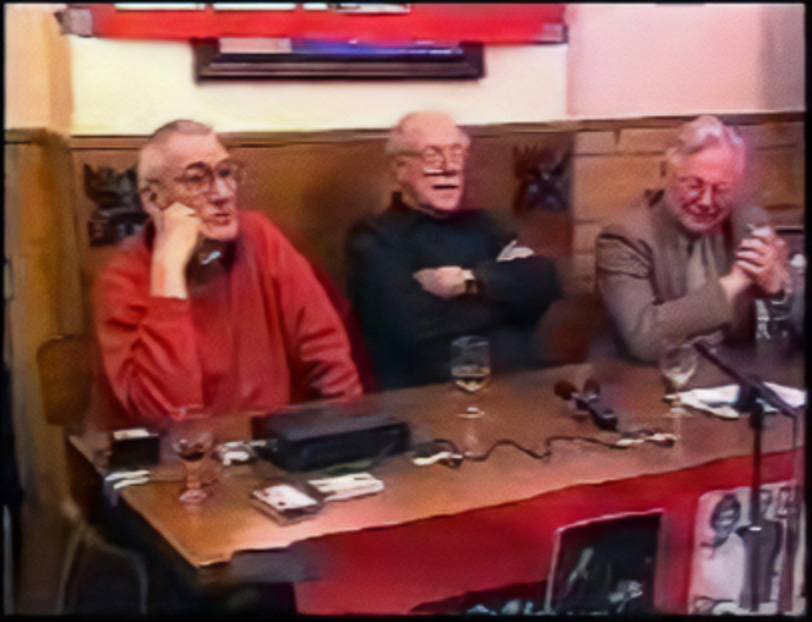
The GSPS meeting at the Wenlock Arms, on Tuesday, 21st May 1996, was known as An Evening Called Fred. It featured a panel of three speakers, John P Hamilton, John Browell and Brian Wiley. The following stories have been edited from a transcription of the video recorded on the night.
Part 1 (below)
John Browell talked about his days working on series 1, acting as Panel Studio Manager on series 3,4 and 5, and then as producer on series 9 and 10.
In Part 2, John Browell tells his inside story of The Last Goon Show Of All.
In Part 3, Brian Willey taks about his days as Panel Studio Manager on series 9 and 10, and we have some memories of Peter Sellers. John Browell tells the Sellers in Rome story.
Part 4 has John P Hamilton recalling his TV days working on A Show Called Fred, then the discussion digresses onto Bernard Braden.
In Part 5 we learn a little about the 1972 Milligna radio series and end with a couple of blooper stories.
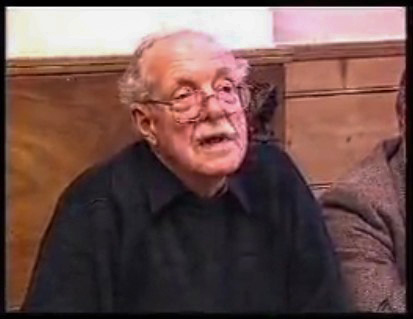
John Browell: May I say first of all that it’s marvellous that there is a Goon Show Preservation Society. There’s not many of us left, and we are worth preserving, or perhaps pickling.
I’ll go back to my earliest recollection. I suppose, I first met a Goon, or what was going to be a Goon, on a programme called Hip, Hip Hoo-Roy with Derek Roy, produced by Leslie Bridgemont. On the script it said ‘written by Jimmy Grafton’. Now you all know Jimmy Grafton’s story, he was a collector of artists and writers at his pub, and he organised them. He had an ‘in’ with the BBC, and he was able to get them work, so obviously people tended to gravitate towards the Grafton Arms.
During this programme I noticed a rather tall, emaciated fellow with a terrible shock of hair wandering about in the background and I asked Jimmy “who is that?”. He said “Oh, he’s a writer. He gets half a crown a gag from Derek Roy. You can tell when his gag is being used, because that’s when he laughs”. And that was Spike Milligan.
My second introduction to a future Goon was with a programme Petticoat Lane, with Elsie and Doris Waters. Do you remember them? No, I’m very much older than you. It had Max Wall on it, and occasional visits from Peter Sellers, who was employed as a voices man. Most radio programmes required people who could do voices. That’s where I first met Peter, and I later met him with Ted Ray on Ray’s a Laugh. We used to go early to rehearsals because Peter liked to play the drums, and he could nip onto the stage and have a bash at the drums for half an hour before rehearsals started, and then we’d go off and have a cup of tea some place.
So that was my meeting with two of them. Harry, I’d met elsewhere and was later to do forces shows with him.
The producer of Petticoat Lane was Pat Dixon. He was a senior producer, and he had the ear of the BBC, it was the Home Service and the Light Programme then, and if he wanted to get a programme on the air, and the local management didn’t want it, all he was to go to Broadcasting House, have a jaw with somebody, and lo and behold, a memo would arrive in the next couple of days saying ‘ we would like a programme with whoever….’. And it so happened that Peter Sellers and Jimmy Grafton had both been on to Pat Dixon, mind you, they’d been on to nearly every other producer in the building, to try and get the Goons on the air. They had an abortive attempt with Jacques Brown which was very unsuccessful. Spike blamed him for doing the show without an audience. I think this is where Spike’s hatred of the BBC stemmed from.
Anyway, owing to pressure from them, and other people, the Goons did eventually get on the air, and Dennis Main Wilson was appointed producer. I was brought onto it for no better reason than I was an expert with The Stargazers. I did the Stargazers broadcasts and I was well known as being an expert in balancing them. The Stargazers were on The Goon Show, so I was brought in. I don’t think Dennis would have had me if he possibly could have avoided it. I did the first series, the one where Roger Wilmut doesn’t know who did it. It was me.
The thing was, I did not enjoy life with the Goons at all. They were brilliant, they were clever, they were young, they were undisciplined. Brash? That’s a good word. It was incredible. Arguments flowed backwards and forwards, sometimes we didn’t even complete a rehearsal before the audience came in, we were still arguing away in the back room. This didn’t suit me at all and I asked to be relieved at the end of the first series. From then on, I forgot all about the Goons, I had other things to do.
So, I left the programme, and it went on for another series, and management recognised that the programme was in a bit of a mess. Michael Bentine left, the house orchestra left, the Stargazers left, and Dennis Main Wilson also left. A young man called Peter Eton was a drama producer, and he came across to the variety department, and he was appointed to the programme. Now Peter Eton had gone through, I use the term loosely, many of the staff at the Aeolian, because he was known not to enjoy fools gladly and he didn’t hesitate to say what he thought if you were not up to scratch. It more or less came about that there wasn’t anybody else left in the department, so I was put on.
I arrived with Peter Eton, knowing his reputation, to find my friend John (Hamilton) and another chap called Ian Cooke, who you probably know of, already ensconced. Strangely enough, Peter Eton and I got on like a house on fire straight away. We took to each other just like that. I had a marvellous team. One could never have wanted a better team to work on the programme. Peter was happy that his effects were looked after by John and Ian, he was happy that the panel was looked after by me, and it left him free to concentrate entirely on the Goons, and he set out to bludgeon them into some form, some shape, and he was very, very successful.
Now Spike, as you probably know, always complained that the BBC overworked him, made him write too much. This gave rise to his illness. One forgets that Eric Sykes, Maurice Wiltshire, Larry Stephens, were all writing Goon Shows, so there were four writers on the Goon Show, and the pressure really existed in Spike’s head.
At this time, the scripts were beginning to become the important thing, they began to have a form. They had a beginning, they had a middle and they had an end. If you wanted to know which scripts were written by Spike, all you had to do was to listen to the end, and if it was blown up, it was Spike’s. Spike didn’t subscribe to the business of ending a show properly. When he’d written enough, somewhere about thirty minutes, good bang, and that was it.
This was the period when the Goon Show really took off, under Peter Eton. He was a wonderful producer. He didn’t care two hoots for anyone at all, he called the Goons ‘the Bums’, and he didn’t mind calling them ‘the Bums’ to their faces if they didn’t do what he wanted. At this period, which is series three, four and five, we really went to town and The Goon Show took off and was the successful Goon Show that you all know.
Then I left the Goon Show to become a producer, which was quite a good thing for me.
Brian Willey: It did your pension a world of good…
John then went on to talk about coming back onto The Goon Show as producer for the final two series.
John Browell: Brian has always been my panel bloke. We tend to acquire people who you get on with and who you can work with. So, I brought Brian in. It was rather a shame for Bobby Jaye, who’d been panel man in the intervening years, and had a stream of producers, mostly producers who were not interested in the Goons at all. They just sat in the chair, with a stop watch, and I think probably that Bobby Jaye was doing as much to produce the programme as anyone. However, I wanted my own chap with me, and so Bobby had to go.
Larry Stephens died, Maurice Wiltshire was not available and Eric Sykes said he wouldn’t write any more of the Goon Show, so I stuck with Spike, and I think that we worked together very well.
May I say that Spike is an absolute genius, but like all geniuses, he’s extremely difficult to work with. Now those who worked in the studio would have a lovely time, everything was great, we got a script and went on and did the show, it was jolly funny, and it was all very marvellous. A producer doesn’t get that wonderful, glorious feeling because he started on the script a week ago, he’s had an argument on the Monday, and he’s had another argument on the Tuesday. He’s had some various alterations made on the Wednesday. By Thursday he manages to get the script out to the cast and the various people. Friday, he would do some rehearsal on the effects. Come Sunday, off we went and did the show.
Spike and I had an arrangement which was if I didn’t like something I could ring him up and tell him I didn’t like it, but I was not to alter one word of the script. Which was fair enough, because he would usually have the same feeling about bits of the script that I had. He knew which were weak spots, so he would rewrite, and I’d get a rewrite on Wednesday. Certain jokes I would leave in for the benefit of the audience. They were the lavatory jokes and anything that was rather naughty but very funny, knowing that I could remove those before the programme went on the air. But there were certain things I did not wish Peter Sellers to see, and those were jokes about money. They had to come out before the script was printed.
He didn’t mind jokes about having twenty cars, making vroom-vroom noises and things like that, but any suggestion that he’d got money, ‘Goldfinger Sellers’, those sort of things had to come out. These involved, obviously, a little argument with Spike, but he lived at Finchley at that time and I used to pick him up in my car. He’s a marvellous man because on the way down from Finchley to the Camden in the car, he would talk happily about last week’s show, about a show that was coming, about ideas he’d got. The moment he walked into the studio, all hell let loose. He was very good in a one to one arrangement, not very good when there were a lot of people around.
The producer was the point of hate. He did not like the BBC, for reasons which we think we know. So when he was working with me, he had this ‘am I going to be nice to John because I know him, or am I going to be nasty to him because he’s the BBC?’. Life was very difficult at times.
I’ve given you the impression, most likely, that all was warfare between Spike and Me, between Spike and the others, things like that. That’s not true at all, because, as you know and you’ve listened to the Goon Show, they’re brilliant, and there’s no two ways about it. But, they were arrived at through blood.
We went on and Spike obviously got on alright with me because he asked me to produce several series with him after the Goon Show finished, Milligna and Friends, and then after a break of ten years we came to The Last Goon Show of All.
Another memory:
John Browell: I remember I once brought my mother to the Goon Show, and Brian, who was very kind, went down after the show to where my mother was sitting in the audience. You said ‘Hello Mrs Browell, did you enjoy the show?’. She said ‘I loathed every minute of it’.
An Evening Called Fred
continue to Part 2 >
 The Goon Show Preservation Society