“We all knew The Goon Show and in a kind of unspoken way
I thought that that’s the sort of comedy I wanted to write”
Mike Brown interviewed Michael Palin in 2008 for our Nesletter no. 132

Having read the 2003 Autobiography of The Pythons by The Pythons, their collective admiration and genuine affection for The Goon Show was obvious. Michael Palin has most to say on the subject, having discovered the shows when he was about eleven. He was eight when they began. His father was a Take it From Here man and didn’t really latch on to The Goon Show, but Michael did and along with his future Monty Python partners, began his comedy apprenticeship with the fertile imaginations of Spike Milligan, Larry Stephens and Eric Sykes and the vocal dexterity of Peter, Spike and Harry. Michael Bentine’s important contribution in the earlier shows had ended when Palin junior joined the listening masses.
Michael’s published diaries, covering the period from 1969 to 1979, have been a major success and explain the Python years and beyond. In the introduction he tells us that he has kept a diary more or less continuously since April 1969, but his first attempt was at the age of eleven. The entry for Tuesday 18th January 1955 reads as follows: “Big blow-up in prayers [?] Had easy prep. Listened to Goon Show. Got sore hand” [?] The Goon Show in question was China Story, but there is no record of that show causing an outbreak of ‘handitis’ amongst the listening public.
The achievements of Michael Palin in comedy both written and performed, in film and television as well as his twenty-year career in presenting world travel, have been enormous. It was with some trepidation that I wrote to him in January 2006 requesting an interview for the GSPS. He wrote to say that his life had got very busy with preparations for a new travel series, but that maybe when things had quietened down a bit there would be a convenient time to do an interview. That time arrived when Michael’s management kindly arranged a telephone interview with him for Monday 7th January 2008.
With his recent series on Eastern Europe gaining wide acclaim and a new year ahead, it seemed to be an ideal time to talk to Michael about his first love of things absurd and his huge contribution to the world of comedy. The phone rang at precisely 9.30am and I drew in a very deep breath!
Mike Brown: How did you, as a child in the 1950s, discover The Goon Show?
Michael Palin: Well I can remember listening to it. I don’t know who put me onto it, though it was probably at school in the early 1950s in Sheffield where word had got around, because I don’t think that I stumbled onto it. There weren’t that many Goon fans around so it was rather selective. I can remember listening to it and just being immediately excited by the difference between The Goon Show and everything else on the radio. There was no television in our house at the time, so all our entertainment was through the radio. My father quite liked radio comedy, but it was shows like Educating Archie, Take it From Here and Much Binding in the Marsh that we used to listen to at teatimes at the weekends. I knew that The Goon Show was something that my father and mother would never understand.
Do you have a Goon Show collection?
Yes, I think I’ve got most of them collected over the years, from compilations that I’ve bought, to contacts at the BBC mentioning shows available.
Who were your favourite characters?
My favourite character was Eccles, but I’m also very fond of Grytpype-Thynne and Henry and Min. Bluebottle was marvellous too. When they came on and you got the tiniest glimmer of what they were about to say, everyone knew who it was. The timing was superb. I bought the Goon records and played them endlessly.
You were the narrator of a production of Nikolai Gogol’s novel Dead Souls on Radio 4. Do you think there is a similarity between Gogol’s fantastic imagination and Spike’s creativity on The Goon Show?
Well I certainly thought, while we were doing this adaptation, that a lot of it was like Monty Python, and the way that Gogol sets things up and then starts playing with convention is also very much like the way Spike did it. That’s what I like about the Goons. They took this rather conservative, conventional form of radio and messed it around. Having thirty seconds of someone coming downstairs to a door and someone saying – “Can I come in?” and then after – “I’ll get the key”, another thirty seconds of going back upstairs to get it. I thought this humour was revolutionary, it was so silly and wonderful. There’s a lot of that in Gogol. It’s the way he sets up people’s expectations. I was the narrator and in the adaptation that we did, the narrator was there as a character, very much in the manner of Greenslade and Harry Secombe. They were there to explain things as well as to get involved. Dead Souls was a very experimental and audacious book in its time.
Do you know of Larry Stephens who co-wrote nearly 60% of the Goon Shows with Spike?
No, I know very little of Larry. In any writing partnership one can be underrated. I’d forgotten about Larry Stephens, [we have sent research material on Larry to Michael Palin] though I do remember Michael Bentine being involved in the first two series.
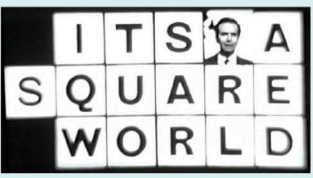
Did you watch It’s a Square World in the early 1960s?
Yes I did. I think it’s interesting that the Goons never really transferred to television and that’s because you have all these characters in your own imagination. Bentine’s show worked so well because of its sketch format.
I remember ‘basking in the glory’ of our Peter Sellers becoming an international star from 1960 onwards, after his nine Goon Show years. Was it the same for you?
Yes, he never really let me down. There were some films he made later on that lost me a bit, but with some of the performances he did in films like I’m all right Jack in the early 1960s and the multiple roles in things like Doctor Strangelove he took on the Americans at their own game. It struck me that there was an element of ‘that’s our boy out there.’ I remember that before 1960 the Top Twenty was pretty much all American and show business was mostly American back then.
Did you ever meet Peter Sellers?
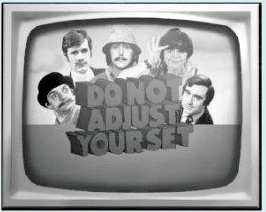
I met him once. We were at the Rediffusion Studios in Wembley to rehearse Do Not Adjust your Set and suddenly, coming out of Make-up, there was Peter Sellers walking towards me. I didn’t know what to do, so I said, “Hello!” in a terribly embarrassed Goon voice, not even like one of his voices. Some years later I did a programme called Comic Roots in which I interviewed Spike. I said to him in my enthusiastic way that I had only met Peter once, having passed him in a corridor at Rediffusion Television. Spike said, “Oh, how very uncomfortable!” That put me in my place. Later on, I knew people who had known him quite well. I met his son and his ex-wife amongst others, but I never met Peter again. His son told me that Peter had said that I was always his favourite Python. So I was quite happy with that, though I didn’t hear it from the man. I very much modelled my love of humour on Sellers. Spike was brilliant. He was an inspirational firework of a character, but not like me, whereas Peter was a really good actor and I thought that was what he brought to The Goon Show. He brought his characters to life absolutely brilliantly and he was a wonderful actor later on.
Following on from that, would you describe yourself as an actor who can write, or a writer who can act?
I would probably say an actor who can write. I only say that because I think there is something fairly instinctive about acting. You can either do it or you can’t. You can improve your technique, you can find ways of playing some characters better than others and finding out where your strengths are. The enjoyment of acting or performing is either there or it isn’t. I can get in touch with that quite easily. Writing is something you are always working at. I don’t think I’ve ever done anything where I’ve felt, ‘ Ah! That is just right,’ apart from the odd page or paragraph. So I feel that I’m always working on the writing side of it. Oddly enough, I find the acting a little easier.
You’re not a RADA trained actor.
I’ve trained in front of audiences and at university. I went to Oxford in 1962 [aged 19] and I remember that one of the first things we bought was Spike’s album Milligan Preserved and, of course, we all knew The Goon Show and in a kind of unspoken way I thought that that’s the sort of comedy I wanted to write. That’s where I wanted to pitch it. There was still a lot of fairly conservative, what I would call ‘cabaret comedy’ still around at that time and I wasn’t free to be truly silly until Do Not Adjust your Set and then, of course, Monty Python. I felt really liberated when we were doing Python movies like Life of Brian and you could be playing eleven or twelve characters, a la Peter Sellers.
How do you account for the longevity of The Goon Show and, indeed, Monty Python?
I think that nothing has come close to outdoing the Goons, and they weren’t outdoing Monty Python. I don’t know why that should be. They were both full of techniques, but I think that they worked really well at the time and the Goons characters were wonderfully portrayed, marvellously played and the stories were extremely silly. Once something is that good, it has arrived head and shoulders above the rest. I think that what the Goons did for radio in liberating it from the old conventions, Python, in a sense, did for television. We were quite in debt to Spike’s Q5 series, including poaching the director. But in some ways it was just a collection of individuals who, at the time, got it right. I don’t think you could get that kind of group together again in quite the same way. It had to do with timing. When the Goons came along, things were beginning to change. Entertainment was controlled by the old guys and the old ways. When Python came along television was changing. We had seen it with Beyond the Fringe and TW3. It had been a serious medium controlled by guys who didn’t know how to be silly.
Spike made 44 Q shows in thirteen years, which was just one less than the 45 Pythons. He also made 19 World of Beachcomber. As many of these have been wiped, how safe was Monty Python?
This is, again, something of a debate. We knew at the time what had happened to some of Spike’s shows and to Pete & Dud. I think there was either a real or a perceived threat. Terry Jones at one time believed that he had the only set of the first Monty Python series, which were recorded on those very heavy Phillips cassettes. This was because the BBC was not obliged to keep these shows. For a time, at least, we were really worried that the rest of Python had been wiped and the only copies around were in Terry’s garage! In the end, they were all kept but it was a very tight run thing with the first series.
That was the way television was at the time. As there were no ancillary manifestations of television in terms of taped DVD, you just did it and hoped for a repeat which was so important then. With just one screening, if people had been out that night they would never see it again in their lives. It would have gone. We felt that with early Python, it would be ephemeral, the shows lasting only a couple of years. It’s been a great surprise to us and an interesting aspect to the way things are done, that Python just survived in time to be shown on video and then DVD. We were very much on a cusp, as shows before didn’t do that. Now they would be like gold dust, Spike’s shows and Pete & Dud’s monologues, etc. We didn’t really expect it then, but now people do because nothing seems to equal the great shows of the past. So there is a great interest in how they did it then and what we can learn. It’s just a pity that they’re not all there.
Spike’s manager, Norma Farnes, remembers Ian MacNaughton as ‘the mad Scot’. What are your memories of him?
‘The mad Scot’. Exactly! He was tremendously manic and had this terrific energy. His face was always sort of scarlet with excitement and he’d rush around a lot. He was a great breath of fresh air after dealing with the kind of quiet, public school-educated BBC staff. We suddenly got this man who loved the silliness of what we did. He loved the word ‘naughty’, he liked mischief and he liked being provocative. He was completely different from the traditional producer / director. We chose him rather than John Howard Davies to do the Pythons.
Of course you knew of his input into the Spike Milligan material at the time.
We were never sure who was responsible for what, but he managed to make the Q5 [also Q6 & Q7] series with Spike which had wonderful things in it and we realised that Ian appreciated what we wanted to do. He wouldn’t be afraid to try something completely different, to coin a phrase! It wasn’t all sweetness and light after that. There were disagreements about how we should do it, but Ian had the spirit of Monty Python which was terribly important.
Would Python have been a lot different without Ian’s input?
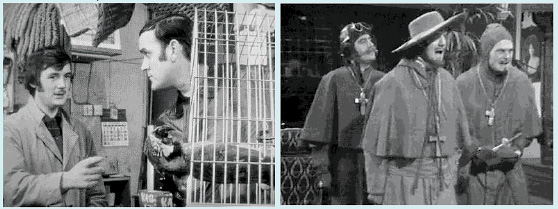
That’s a good question. What happened was that we ended up doing it ourselves. We had two directors in our midst with Terry Jones and Terry Gilliam, and we had very strong characters like John Cleese who knew exactly what they wanted. In 1969 when we started there were very few options. We were not going to be given a series to direct ourselves. That was not how the BBC did things then. Nor was there any independent alternative, as there is now. We couldn’t start our own little company and sell the show to the BBC, so we had to use who was around at BBC Television. I think that Ian let us go in certain directions, not always the right directions, but it was very important to make Python different from what came before. I think that if we had had someone slightly more conventional, you still would have had some of the wonderful sketches like The Dead Parrot and all those, but a lot of the pieces of filler material like people hitting each other in suits of armour with chickens, may have had the director saying, “No that’s just not funny.”
Do you think that you would have been reined in a bit?
That’s exactly it. I think that Ian MacNaughton allowed us to use the full flow of our imaginations.
Do you still get ideas for comedy sketches or written pieces, and if so, do you write them down before you forget?
I don’t write things down now as I’ve been very much geared to making these travel series. But I do get ideas and see in some situations how you deal with modern life, and how Python would have dealt with it. With PC World and all that sort of stuff, we would have done really well, but I don’t write it down now. Perhaps I should. We get together occasionally and have a clear-out of ideas and have a good laugh. Way in the back of our minds is the thought of perhaps doing another show another day, but everyone is off in so many directions. The comedy and the humour and the way of looking at life that Python was, and the Goons were, is always there in my mind. I haven’t changed in that way. People think that you’ve become a television documentary maker, but I still appreciate the silliness and the inconsequentiality and absurdity of it all. I do think that the best way to deal with a lot of material is the way we did it through Python and before that, the way the Goons did it. When people ask me to pontificate on transport problems and climate change, etc. I’m not a pundit in that way. I don’t have that kind of information. I see, as all comedians do, round the back door to the view behind and the absurdity of it. Sometimes that’s not a pleasant way, but that’s where humour flourishes and it cuts us all down to size.
Do you miss writing comedy for television with, for example, Terry Jones during the last twenty years?
Well I don’t miss it, in the sense that we did some really good work together, both with the Python group and just myself with Terry. It came to a natural end because I think we both had different areas that we wanted to go towards. Terry is slightly more into fantasy and I’m more towards reality and more observational stuff. We just went off and we are still really good friends. Maybe we would do something together again. So I don’t feel that something was cut off before it was achieved or before its time. My television writing career was ten or fifteen years of great productivity. It moved on a little into films and then onto travel. I’m a restless person by nature. I like to be doing different things, so I miss the writing in the sense that I’d love to be sitting in Terry’s back garden coming up with really daft things like The Spanish Inquisition, or whatever, but we have done it the best way we could and we can’t snap our fingers and bring back the same conditions. If done now it would be very different. The world has changed and it’s a different time.
At this point the twenty minutes allocated for my interview had stretched to thirty-five and my fascinating chat with Michael Palin had to come to an end, with many more questions left unanswered, as he had another interview to attend to. My trepidation had, of course, been entirely unfounded. Michael is a delight to interview and his deep affection and admiration for all things Goon was obvious.
I thanked him on behalf of the GSPS for giving his time to us and asked if he would consider being a guest of the Society at a future London meeting. Let’s hope that this can be arranged.
 The Goon Show Preservation Society