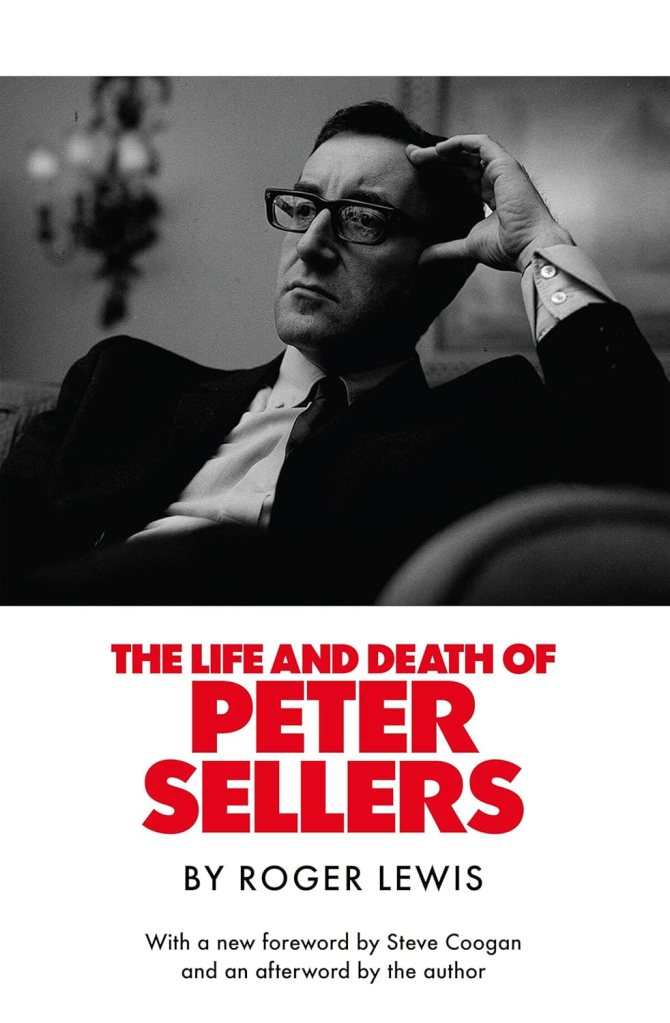
One of the happenings around the centenary of Peter Sellers’ birth was the issue of a new, mildly augmented, edition of Roger Lewis’s biography.
Lewis was a guest on Tyler Adams’ GoonPod podcast, where he talked about his admiration of Sellers, and that the book was his personal view of the man as he found him. You can listen to the podcast here:
Looking back, there was much anticipation in 1992 for the forthcoming publication. In our January newsletter, Roger Lewis provided an update:
Sellers Biographer Speaks
It is getting on for four years since I started to work full time on a biography of Peter Sellers. I’ve always been fascinated by his brilliant acting ability — and, I must say, his self-destructive, melancholy private personality absorbs me, too. The point of my book is to see the overlaps and discrepancies between the two elements: the actor and the man. I’ve interviewed about 300 of his friends and enemies; alarmingly, dozens of these have dropped dead since I spoke to them. Is there a Curse of the Pink Panther? Theo Cowan, Capucine, Andrew Timothy, Raymond Huntley, Dimitri de Grunwald, John Redway (agent), Terence Baker (producer)
Though there have been plenty of books on Sellers before, and some of them are quite good, I think it is generally agreed that a full-scale study is in order – something deeper and more substantial than a best-pal’s memoirs, accounts of family feuds, journalistic knock-off’s, etc.
Alex Walker’s biography is considered the most authoritative, but in my opinion it is flawed seriously because (i) its interpretation of Sellers is slanted towards the fourth wife, Lynne Fredricks (ii) it contains many omissions and errors of fact, and (iii) it contains little critical discussion of the films. All that said, it is still well-written and, given that it came out within months of Sellers’ death, quite an achievement. But for me, digging in the archives, meeting and interviewing people who knew Sellers, discovering material first hand, I can say that all too often Walker relies on an accepted view of Sellers. And his main problem: he does not verify any of his quotes or references or sources.
Would I have liked Sellers, had I met him? When I meet people (and there have been half a dozen) who make a big thing out of having been close to Peter, his big chum, I think, God, if Sellers liked you, I don’t think I’d have fitted in At other times, when my research and ideas bring me up against the quiet, reflective, almost frail Sellers — the Sellers of Topaz, Battle of the Sexes, Dock Brief; The Blockhouse – I think, yes, I could have understood you. But then, this is the thing about him: we create the real Peter Sellers in our own image!
I must say, the resources and personnel of the GSPS have been invaluable. George Brown especially has unearthed vast amounts of research material; the tape library contains useful interviews and features. So valuable is a lot of this material to future historians of broadcasting and film, might I make a suggestion that, in due course, some university library hand over squillions of quids in exchange for it all?
I have still a long way to go: research is never completed, only abandoned. I’ve not seen A Day at the Beach — it seems the prints were destroyed. There is a never-ending queue of people to see. For example, I recently found Sellers’ old butler, from the Britt days
The book was published in 1994, and it contained many criticisms of Peter Sellers. Our newsletter in July that year carried this review by Stuart Monk:
The Life and Rewrite of Peter Sellers…..
a look at Roger Lewis book from the GSPS-type point of view…
I think it is only fair to approach a book with as many pages as this with expectations of new material; and I would be lying if I claimed that Mr. Lewis has not provided a great deal of extra detail from the life of Peter Sellers. If you. dear reader, do not yet have any or all of the previous biographies, then your £20 will be well spent on this book. Facts, however, Lewis supplies a large amount of speculation and makes inferences and accusations which I feel are not always supported by Facts.
“He had an evil streak in him. Sellers was evil….He was a destroyer. He was pandemonium.”
As an appreciation of Sellers’ skill as a comic actor, pans of this book should be compulsory reading for students of comedy, and I feel Lewis is at his best in telling us how good Sellers could be, particularly in the earlier, less obvious films. It is in these films that Sellers can be seen developing Comic Acting into a new dimension.
“Sellers…” renounced love in order to gain power”
Sadly, Lewis spoils his book, in my opinion, by a relentless and unforgiving catalogue of the sins of Peter Sellers, in greater detail than previous biographers who actually knew the man. Lewis notes a number of times that he never met Sellers, but I left the book feeling that he had deeply offended Lewis – I wonder what Lewis‘ biography of Hitler would be like?
Sellers yielded to (evil), he embodied it. There was a darkness wheeling about him. There is the strong impression I am left with.… and I don’t believe my intuitions can totally be discounted as those of an author who….starts to resent his subject for consuming so much of his life, though there must be a bit of that abroad, too. Sellers was petulant, ecstatic; he was brutal and intense.
There is no attempt made to tell a chronological life story of Peter Sellers, and the reader is pulled from the days of his childhood to his last attempts to restart his career from sentence to sentence, or so it seems. Call me old fashioned, but I would have liked to have seen the author, who had so much information at his fingertips (supplied by our own popular George “namecheck” Brown), set out some appendices on the history of Sellers’ Radio and TV work, with listings to make a boy cross-eyed. Lewis obviously had access to some very interesting material and, well, we have the right to know !
I think that is a significant fault of this book, and all previous biographies: nobody has bothered to spend enough time on detailing any part of Sellers’ career except films, and we would not be here without his radio work.
If the GSPS has a list of VIP Honorary Members, then I would still nominate Roger Lewis, because of his open appreciation of the endless ferreting of Brown George and other stalwarts of the society; but I feel Strongly that this is still not the definitive Sellers Biography, since it presents so much distaste for its subject. There is little left to say, however, apart from the omissions I mentioned earlier, and so I feel that Sellers as a subject of biography is all written out. Shame.
The Peter Sellers Appreciation Society went further in its dislike of the book. Their critique is reproduced here.
 The Goon Show Preservation Society