If you’re a big fan of a singer, movie, show or personality, what can you do to declare or promote your interest? Nowadays, all you need is a smartphone to start a Facebook group or a Twitter account, or shoot some videos for TikTok. But what if the subject of your obsession was The Goon Show, and it was the 1950s. What then?
What a year 1956 turned out to be for the Goon scholar! The Case of the Mukkinese Battlehorn was released in cinemas during January, even as The Goon Show Series 6 continued on the airwaves. Then, on TV The Idiot Weekly Price 2d was in full swing, later followed by A Show Called Fred and Son of Fred. What’s more, The Goon Show Series 7 began its own 26 week run on 4th October, continuing well into the following year. Into this growing mix of Goon fever came…. The Goonist Movement.
The GSPS has been aware of the Goonist Movement for many years, but it had been little more than a mythical name. Back in 1975 we were loaned a copy of one newsletter, but there was no information to be found elsewhere.
A final plea for information, published on this website and in Goon Show News in 2023, brought only one response. That came from Ian Gilbert, who thought there was some material among family keepsakes which were kept “on a shelf in a safe place”. This turned out, to mutual surprise, to be the full sequence of magazines from first issue to last letter. We’re immensely grateful to Ian for allowing us to make copies of those. From them, we can now piece together the Goonist Movement story.
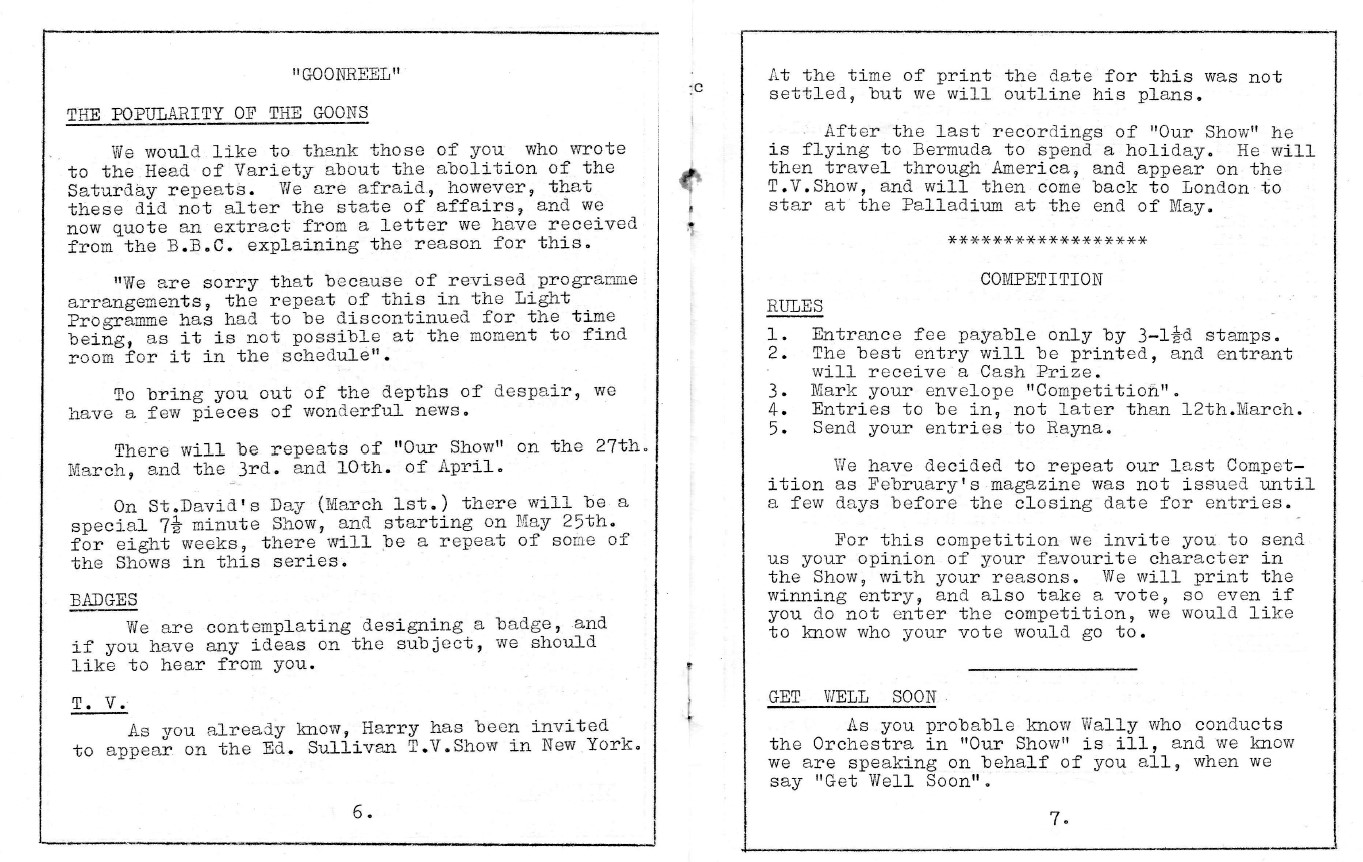
The only “leading lights” in the Movement appear to have been Rayna Allen and Joyce (no surname). They started working on this idea around the start of November 1955, with press adverts being placed to gauge interest (much as Mike Coveney would place GSPS adverts in Private Eye some years later). The first magazine was published in January 1956, each copy’s opening page personally signed – something which didn’t last long! Growing interest and a membership over 500 by April, meant such kind personal touches (also wishing “happy birthday” to members each month) quickly became impractical. The increase did mean that Rayna was able to launch a “London Branch” as she was based in Hackney. Suffering from after-War housing problems in the 1950s as Hackney did (and rationing did not end till mid 1954), the Goonist Movement must have been a hugely exciting adventure for her.

Their newsletters had the same modest printed title cover except for the first two editions, which look constructed with the aid of a letter stencil, with only 8 inner pages. The other covers used the same printed design and all the editions were produced by a local printer. Issue 1 was printed all in red ink and issue 8 experimented with red and green paper. It’s too easy to forget that the Fifties were not flush with disposable cash (unless, perhaps, you were Peter Sellers), so producing anything like this represented a financial challenge. More surprising is the fact that they produced one each month.
The bulletins included fan-inspired pen portraits of Bluebottle and Bloodnok, as well as one Goonish page-long feature “Wanted – a Wife” (was this guy serious?). One issue notes international Goonists in “Australia, South Africa, Bermuda, China, Israel, Egypt, India, Malaya, Germany, France, Cyprus and Malta”. Quite a spread, but there was nothing from the USA, no Herns (yet)! It looks like responses came only from places where the Goon Show had been rebroadcast on the General Overseas Service (now World Service) and heard by British expats or soldiers posted abroad. A growing feature of the issues was Pen Friend requests, with ages ranging from 14 to 30 with the majority being between 16 and 22. This was a young Fan Club! Several were from guys aged 19-22 doing military service overseas. One person wanted to invite nearby invited members “to share listening of his recorded Goon Shows….” (Quick! Where was he based??).
The editions contain a lot of information about up and coming performances by the Goons, in theatre as well as on TV. Issue 2 carried a report on seeing Peter, Spike and Max Geldray at the Empire Theatre, Chatham. Other issues included news about Harry’s time at the London Palladium.
They rapidly had an impact on the Goons – January’s The House of Teeth included a mention of “The Goonist Movement” (though that disappeared when it was edited for length). Messages from Spike or Peter (Harry had his own fan club, which complicated things) were relayed, leading to the front-page subtitle “The Official Club for the Goon Show.” Peter seems to have somehow signed a message for issue 7 and Spike (I suspect, in a hurry) contributed a brief piece for issue 3! Each mag featured biography info about one particular member of the Goon Show team. Harry was spread over two issues (how painful…)!
They also contacted the BBC about the Show’s Saturday repeat slot being cancelled, as well as about audience research feedback published by the BBC General Overseas Service (later BBC World Service), anticipating the role later performed by GSPS with BBC Enterprises and BBC Radio on the matter of requesting repeats.
Although Rayna (and Joyce early on) were known to the Goons, they firmly told everyone hoping to write directly to the Goons that private addresses (or phone numbers!) would not be disclosed. Rayna did get an invitation day pass to the TV recording of A Show Called Fred (#4) and her report sounds excited and not a little in awe of the entire TV production process. She had to write up the event from memory, not having taken a notebook with her. Rayna was latterly remembered by the Goons as well; in the February 1973 One Pair of Eyes documentary Spike is talking to Peter in a London high street, and she crops up briefly in their conversation, nearly 20 years after the Goonist heyday.
Some members expecting immediate responses to their letters get reminded that “we do have full time jobs and we only run The Club as a hobby” (some things don’t change!). However, they encouraged all members to respond vigilantly to any “degrading” press reports about the Goons by writing to complain to the staff reporters. There were regular reminders to include a Stamped Addressed Envelope to guarantee a reply. Rayna once implied there could be as many as 50 letters in a week that came without SAE and she spent money on stamps anyway. The official postbag through the letterbox must have been amazing. She still had to buy those stamps with something… and what about the phone bill for contacting those members about the unexpected Goon-ish theatre tickets? Had to come from somewhere.
On top of this, they did invest in gifts for the Goons. Spike was bought a wallet. Peter was bought a pair of bespoke, 3mm thick, 9 carat gold cufflinks for his birthday that year in the shape of the letters P and S. That’s an expensive trinket….. how was it paid for? People were invited to send contributions in towards such gifts but were they enough to cover the costs? The magazine never says anything on the subject.
Ominously, in issue 7 Rayna responds to people who had asked for ideas about how to set up a Fan Club. She had lot of advice to offer, but one thing that was almost top of the list was approaching the artist in hope of getting an agreement to finance the Fan Club. They had no such deal in place. Could it be that she was beginning to see costs spiral away from the resources to hand?
… and then, almost as soon as it had started, the Movement officially came to an abrupt end. Instead of issue 12 with the promised tale about how it all began, just a single sheet letter to all membership announcing that the Movement was shutting down. Why?
Sadly, it all came down to money – or, the lack of it. Joyce had stopped organizing mid 1956, but someone else (no name reported) had volunteered to help Rayna with the magazines and huge mailbag. Issue 4 explained that the membership fee, all 3/6d of it, later a princely 5/- (or 25p in today’s farthings) was intended for proper magazine printing, envelopes and postage. Even when second class post was less than 1p per stamp in those days, it all added up and left little flexibility in the budget.
In December 1956 the only thing to plop through members’ letter boxes was that single page letter announcing the end of The Goonist Movement. The three Goons had been approached for help with covering the due expenses, a request that Peter ignored while Spike plead poverty. There are no real details of what the liabilities were. Harry, bless the man, did make a typically kind and substantial financial intervention that enabled members to have subscriptions refunded if necessary.
Scanned copies of the Goonist Movement magazines have been added to the GSPS Digital Archive and will be included in the next edition of Encyclopaedia Goonicus.
This article by Chris Smith originally appeared in the June 2024 edition of Goon Show News. It was adapted for the website by Duncan Gray.
 The Goon Show Preservation Society