To celebrate the King Charles’ continuing patronage of the GSPS, let’s have a look back at one of the earliest connections between the Goons and royalty. The story involves the Goons representing Charles’s father back in 1958. It’s the tale which inspired episode 24 of the eighth series of The Goon Show, Tiddlywinks.
The story started with a headline in The Spectator magazine on 18 October 1957. It read ‘Does Prince Philip Cheat at Tiddlywinks?’. This wasn’t actually a scurrilous attack on the prince, the article was about the unfairness of press criticism of the Royals, who couldn’t answer back. Oh, that these people could see the modern social media world!

The headline was spotted by members of the Cambridge University Tiddlywinks Club, a society which had been formed two years earlier. It had risen to be regarded as world champions in the ‘sport’, perhaps because they were the only people taking this children’s game seriously. The club still thrives, it’s a fine example of British eccentricity which recently celebrated its 70th anniversary.
The club wrote to Philip, Duke of Edinburgh, offering him the opportunity to prove that he was not a tiddly cheat, and challenged him to a match. The Duke proved to be up for the challenge, though not to the extent of him actually turning up and playing. It was agreed that a grand tournament would be played to benefit the National Playing Fields Association, of which Philip was president. The club had long wanted to challenge the Goons to a match, and it was decided that they would be Duke’s Royal Champions.
(As an aside, another personality whose name is familiar to Goon Show fans had declined to compete in a match, none other than Lady Docker!)
So it was that the invitation was made. Spike Milligan responded by actually sending a real hide leather gauntlet (price 17s/9d) by registered post to the university, as a symbol that the challenge was accepted. The match was on. The date was set for Saturday 1st March 1958, the venue was Cambridge’s Guildhall.
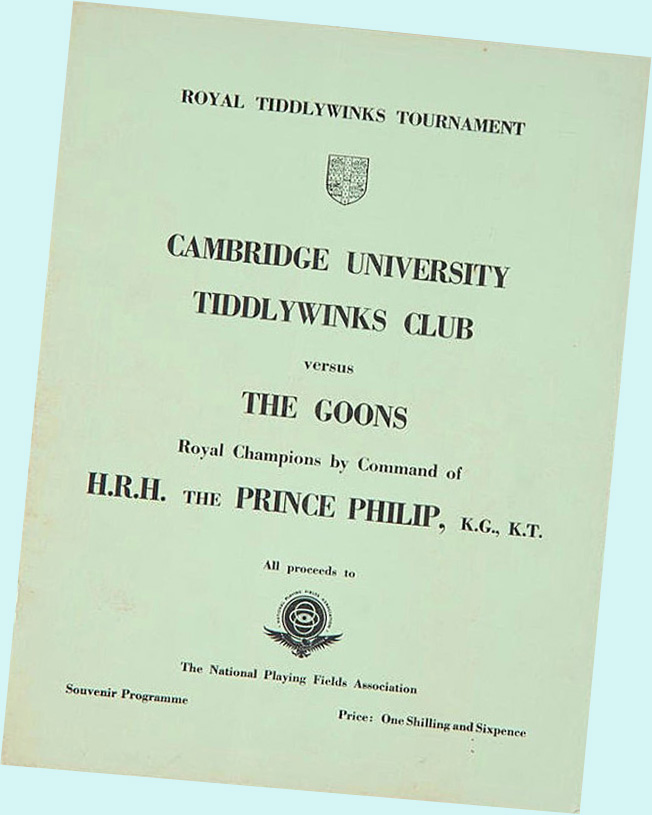
On the day, the Goons team sheet read, S Milligan & H Secombe; P Sellers & W Greenslade; M Geldray & G Stark (substituting for R Ellington); A Simpson & R Galton. The team came dressed in long yellow cotton sheets with orange, yellow and black school caps. The Cambridge team, on the other hand, wore dinner jackets and bow-ties. Allegedly, an unsuccessful attempt was made to abduct one of the star players, Wallace Greenslade, at Cambridge Railway Station, to prevent him reaching the venue.
Each side had provided an umpire. John Snagge was there for the Goons, while Cambridge had called up one of their famous graduates, Olympic Gold Medallist Chris Brasher.
The match had been attracting widespread press coverage in the lead up and on the day the Guildhall was full. The crowd capacity was about 600, with the best front row seats costing as much as 5 shillings. They also had film crews present from BBC TV, ITV, CBS, Pathe News and British Movietone. All the newspapers were there, and there was coverage for the wireless too. The well known radio personality and later stalwart of Test Match Special, Brian Johnston, was on hand to record a commentary for later transmission.
The audio recording of the event, including the Brian Johnston commentary, can be found on The Goon Show Compendium Volume EIGHT. It’s a great listen.
The event started with John Snagge reading a message from Prince Philip.
Please give my best wishes to the two teams taking part in the great contest but try, if you can, to do it in such a way that you convey that I wish the Cambridge team to lose and my incomparable champions to win a resounding and stereophonic victory.
At one time I had hoped to join my champions but, unfortunately, while practising secretly I pulled an important muscle in the second or tiddly joint of my winking finger. This is naturally very disappointing, but at least it gives my side a very much better chance to win. Wink up, fiddle the game, and may the Goons’ side win. – Philip
Then came the match, played with great jollity involving players and audience alike. By the half-time lunch break, Cambridge were forging ahead and Spike reportedly sent a telegram to the Prince: ‘Prepare to abandon ship, (signed) Royal Champion’.
In the end, Prince Philip would be disappointed by the result. John Snagge announced a win for Cambridge by 120½ points to 55½, which sounds a bit better than 16 games to nil. A protest was made, accusing Chris Brasher of failing to obey the Royal Command and refereeing the game fairly.
More fun followed, at one point, Secombe tried to auction off a leek he’d been given. The Sunday papers reported that the girls selling programmes were tied up, and the programmes sold at £1 each to benefit the NPFA. The cover price was one shilling and sixpence. Undergraduates in pyjamas were parading “Eccles Must Go” placards. Eventually the formalities were completed, and the day closed with him leading the singing of The Tiddlywinks Anthem (a set of lyrics set to the tune of “Men of Harlech”) with the audience joining in.
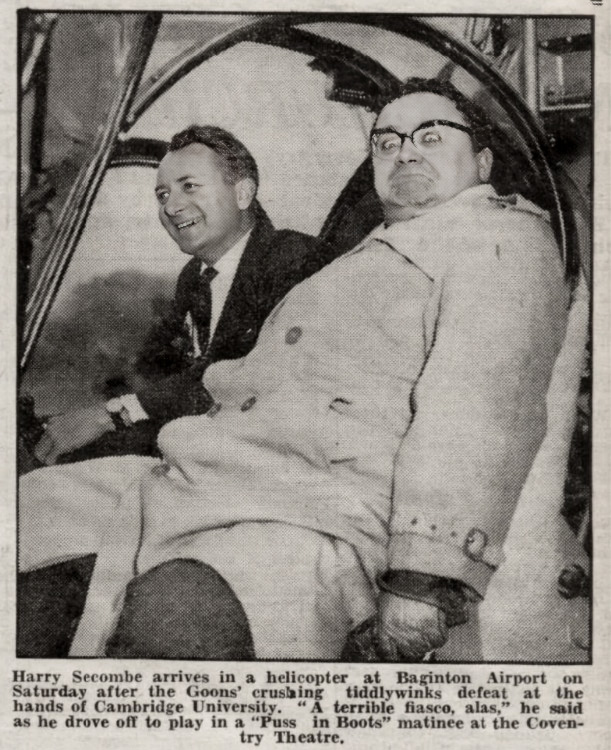
The whole event had been a great success, and £225 was raised for the NPFA. However, when Harry Secombe was buttonholed by a local reporter as he got out of the helicopter which had flown him to Coventry in time for an afternoon matinee performance of Puss in Boots, he described it as ” A terrible fiasco, alas”.
Just eight days later, the Goons gathered at the Camden Theatre to record that week’s episode of the Goon Show, by which time Spike had produced a script, partly based on the tiddlywinks match. After a time-filling first third of the show, spent highlighting Sellers’ obsessions with motor cars, cameras and a touch of the tape recorders, they got round to the main subject:
Seagoon: There we were, dressed up like idiots, poppin’ little buttons into a cup. And still no signs of a knighthood.
The theme of the show was revenge, the Goons planned to get their own back by challenging Cambridge to a leaping contest and cheating by using rocket-propelled boots. No good comes of cheating of course, and John Snagge came in at the end to punish Neddie for his indiscretions by making him raise his right leg, face east and sing the Tiddlywinks Anthem again.
A footnote: the show included a line based on another news story of that week, one involving a lamppost:
Peter (playing the part of A E Matthews): I’m not moving from here until you take that blasted concrete lump away.
So followed the next week’s episode, with Mr A E Matthews and The Evils of Bushey Spon. But that’s another story.
 The Goon Show Preservation Society