by John Repsch
When Peter Eton landed on The Goon Show in 1953, the effect on it was seismic. To the Goons he suddenly brought bared-teeth discipline; the concept of a one-story-show as opposed to three; and a world of sound effects and microphone techniques to massage the imagination. He also brought them Valentine Dyall.
As The Man in Black presenting radio’s horror series, Appointment with Fear, Dyall’s deep dulcet tones had been sending shivers up and down British spines since 1943. He had also been kept busy on the London stage and playing supporting roles on film, most notably as the Duke of Burgundy in Henry V. But none of it was leading to anything meatier, and he resented the typecasting effect that endlessly playing the Appointment with Fear‘s ‘storyteller’ was having on his career:
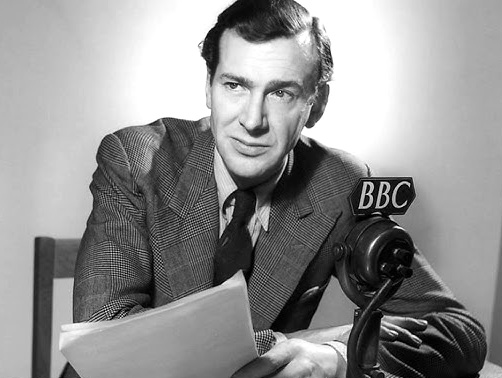
“It’s terribly bad for one’s trade. You go and play the Duke of Burgundy in the film of Henry V, and then people suggest that you should do a trailer for it, and people who shall be nameless – Laurence Olivier, I know him quite well – say, ‘We don’t want a Man in Black voice for that.’ No one can say a Duke of Burgundy voice or anything of that sort. I always thought [my voice] was just a deep voice. It wasn’t a Man in Black voice. People used to say, ‘You have a splendid deep voice.’ They didn’t say [in a deep voice], ‘It’s a Man in Black.’ Anyway, it never was as deep as that. The Man in Black was always a very gentle person. He was very purry to the microphone.”
Enter Peter Eton. Keen to add more depth to the characters and to bring some pomp and circumstance to proceedings, he remembered the Shakespearean actor with the impressively commanding voice: “I brought Val in – when I was trying to make them slightly more dramatic. I had been doing The Man in Black as a play producer, actually with Val. I introduced him to Spike, and Spike loved the voice and so he started writing for him. He always had a thing about Val.”
There may have been more to it than that. Many years later, Spike attended a GSPS event and spoke sadly of Dyall’s horrendous home life. Valentine, he said, regularly suffered the effects of a violent wife. He would arrive for work sporting black eyes, and on one occasion she threw a frying pan at him, disfiguring his face to the extent that it gave him a hard-hearted look that subsequently severely limited his career, perhaps destroying his chances of becoming a major star.
Dyall was to become the most frequent of the Goon guests, making appearances in ten titles: The Tragedy of Oxley Towers (3/14); The Canal (5/6); The House of Teeth (6/20); Drums along the Mersey (7/2); The Spectre of Tintagel (7/5); Robin Hood (7/SP); The Reason Why (7/SP); The Giant Bombardon (VG/4); The Spy or Who is Pink Oboe (9/11); The Silver Dubloons (10/5).
In February 1953, he started taking scene-stealing roles in what turned out to be some of the most popular shows made. Take The Canal, for instance, with Spike’s introduction from ‘The Goon Show Scripts’ (The Woburn Press, 1972): “Young Ned Seagoon returns to Seagoon’s Folly, the ancestral home, to find it empty save for a sinister oriental valet, a refugee heroin importer and Gravely Headstone, the butler. Where is Seagoon’s father, his four mothers, the first cook, the underfootman and the over-footman? All Ned’s queries are met with silence. Then one night, three mysterious strangers are seen digging a grave nearly fifty feet long in the rose-garden. Hollow knockings and weird moans are heard in the buttery and Strangler Aagonschmidt, a notorious schizophrenic, is discovered in the act of setting fire to the library. Why is there a secret passage from the grave to Seagoon’s bedroom? What is the secret of the canal? Most of the action takes place in a walled-up tomb in the crypt of Seagoon’s Folly. Mysterious knocking recorded by permission of The Poltergeist Society of Lower Regent Street.”
F.X. DOOR OPENS. GONG.
LORD VALENTINE Neddie!
SEAGOON Father! You – you are Father, aren’t you?
LORD VALENTINE Do I have to undress?
SEAGOON No, it’s just that you’ve changed so. (Aside) And, dear listener, changed he had – he looked tired, weary – his eyes were sunk back in his head, they were bloodshot, watery and red-rimmed – what had caused this?
LORD VALENTINE Neddie, we’ve bought a television set. But what are you doing back from school?
SEAGOON My schooling is completed.
LORD VALENTINE Nonsense, you’ve only been there forty-three years.
SEAGOON Nevertheless, I came out top boy in the entire kindergarten.
LORD VALENTINE Really? Then it’s the diplomatic service for you.
FLOWERDEW (Approach) I’m a daisy – a beautiful daisy – please, brown cow, do not eat me – nor my friend the pansy – where are you, Ivor?
SEAGOON Good heavens – wasn’t that Uncle Rupert?
LORD VALENTINE Yes, he’s better now. Neddie, now that you’re home, promise me one thing.
SEAGOON Very well, Father, I promise!
LORD VALENTINE Thank you. See that you keep it.
SEAGOON Ying tong iddle I po.
LORD VALENTINE Good. Promise me one more thing. Never – never – go near – the canal.
SEAGOON Why not?
LORD VALENTINE (Flaming) Just never go near the canal, that’s all.
Having sealed Neddie’s feet in three-ton concrete blocks, and inserted sticks of dynamite, Lord Valentine telephones Lloyds Insurance: “Hello, Lloyds? Yes – new life policy, please – I want to insure Neddie in the event of his ever putting concrete blocks on his feet, blowing himself up with dynamite and landing in the canal. Yes, I know it’s not likely to happen, but just in case.”
The novelty of actually contributing to the storylines, as opposed to presenting and commenting on them in his atmospherically sinister style, must have been immensely inspiring. You can well imagine him sinking his teeth into the demented dentist, Dr Longdongle, whom he played in The House of Teeth: “Who is the ghoulish Dr Longdongle? And why has he a weakness for a nice smile? What was the fiendish promise made to him by sultry Signorita Gladys de la Tiger-nutta, queen of the castanets? Why are guests at his mysterious castle forced to become vegetarians? The surrounding peasantry live in fear until, one dark and stormy night, intrepid young Lord Seagoon, on a sight-seeing trip in his horse-drawn motor car, knocks at the dreaded castle door. Screams in the night and a trail of toothless men in brown paper nightshirts lead him to the steaming atmosphere of the notorious Café Filthmuck, where the grisly secret of the House of Teeth is finally revealed.”
BLOODNOK I say, why are you staring at me like that?
DR LONGDONGLE Your teeth – are they false?
BLOODNOK Oh yes, oh yes. What’s more, they’re of great sentimental value. You see (Tearful) they belong to my great-grandmother.
DR LONGDONGLE It must be wonderful to have a family heirloom.
BLOODNOK Yes, do you mind if I take my kilt off, it’s hot in here. Oooo!
DR LONGDONGLE What’s up?
BLOODNOK That lump in the carpet – it moved.
DR LONGDONGLE Yes – it’s the only carpet in the world with a moving lump.
BLOODNOK It must be valuable then.
DR LONGDONGLE It has great sentimental value – you see (Tearful) that lump belongs to my mother.
BLOODNOK What a lovely heirloom to leave behind. A large lump. Oh, people aren’t as thoughtful these days.
DR LONGDONGLE This bucket you see is also an heirloom – just bend over it and look at the bottom.
BLOODNOK I can’t see anything to –
F.X. WALLOP, POP, CLANG
BLOODNOK (Gums) Ohh, me choppers –
DR LONGDONGLE Got ’em. Ha ha ha ha ha.
F.X. DOOR BURSTS OPEN
SEAGOON Not so fast, DR LONDONGLER. Where are you hiding these men’s teeth?
OMNES Teeth. We want teeth.
DR LONGDONGLE Silence – don’t move, any of you, or I’ll shoot.
SEAGOON Fool – put down that tin of potted shrimps.
DR LONGDONGLE And starve to death? Never.
SEAGOON Londonker, I’m willing to bargain with you.
DR LONGDONGLE What’s your offer?
SEAGOON These outsize ladies’ bloomers at three and eleven pence.
DR LONGDONGLE Fool, the ones I’m wearing only cost two and nine pence.
SEAGOON Curse, I’ve failed. Very well, another offer. Give these men back their choppers and we’ll see you get a fair trial, shot dead, strangled and set free.
DR LONGDONGLE No.
SEAGOON Why not?
DR LONGDONGLE You might be lying, and it sounds risky.
As the Sheriff of Nottingham in Robin Hood, he captures Neddie and exhibits a particularly gleeful malevolence as he lists his plans for him to a squeamish King John (played by Dennis Price):
SHERIFF All your ills will be gone by dawn tomorrow, when Robin Hood will be hung, drawn, quartered, clubbed, struck, lifted, lowered, hurled, stretched, drowned, dragged, drugged, bashed, bonked, thudded, tweaked, walloped and then splugged on a gillikin spike.
KING JOHN Do you mind if I sit down?
SHERIFF No, throw the wretch into dungeons dark and dank.
NEDDIE You’ll pay for this.
SHERIFF Nonsense, we get it all free on the National Health.
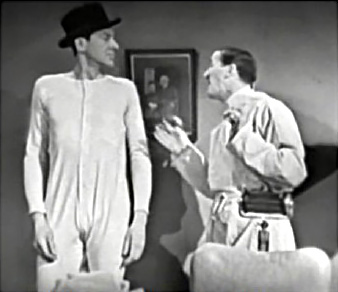
1955 provided his final series of Appointment with Fear, but his comedy roles continued. The following year a further opportunity to exorcise the ghost of The Man in Black came with some Goon-inspired television shows – Idiot Weekly, Price 2d, A Show called Fred and Son of Fred – which could not have been more different from that much-loved chiller. Heaven knows how his fans reacted to the sight of their tall, gaunt hero swinging upside down in his longjohns, assuring viewers: “No, I’m not mad really. I just help the others out when they’re busy.” Later in that episode he is seen brandishing a box of Muc wonder detergent as he strides, head held high, in suit and tie but shirt-less, along backstage corridors to the studio canteen, where he proceeds to do the washing-up.
Playing a variety of parts, there was something slightly pathetic about him, a touch of ‘how the mighty have fallen’, whereby he was being made to pay the price for Milligan’s and Sellers’s anti-establishment and anti-authority crusade. Dyall represented what they loved to hate, and pricking the pomp by poking fun at him was the best way to demean him. On the other hand, Dyall was an actor, period. Actors act and good actors want to stretch themselves. He was doing just that. At the same time he was looking to earn an honest crust.
He drew a simple comparison between himself and the much put-upon dowager in the Marx Brothers films: “I’m the Goon equivalent of the Marx Brothers’ Margaret Dumont. She’s Mrs Dukesbury, that superb matronly figure in tiaras, big bust and black lace, nearly always insulted by Groucho.”
Valentine Dyall went on to star in the Antrobus/Milligan cult-classic The Bedsitting Room and much more comedy and drama in a long and distinguished career as a character actor.
In latter years he cast his mind back to the role that had made him and seemed less eager to string him up and tear him limb from limb: “I think on the whole I should be more grateful to The Man in Black than I’m cross about him. I’m grateful to the old boy.”
This article was first published in Issue 153 of Goon Show News, August 2016. That newsletter also included a longer feature on Valentine Dyall.

